Smoking, Sophistication and Vice in British Youth Opera’s The Rake’s Progress
When British Youth Opera presented Stravinsky’s The Rake’s Progress at Battersea Arts Centre in London in August 2026, the production transported the opera’s story into the hedonistic world of the 1980s.
It was a setting in which pleasure was offered without consequences, appearances carried enormous weight, and smoking could immediately suggest sophistication, temptation and vice.
To help create that world on stage, the production used Stage Props professional theatrical cigarette props.
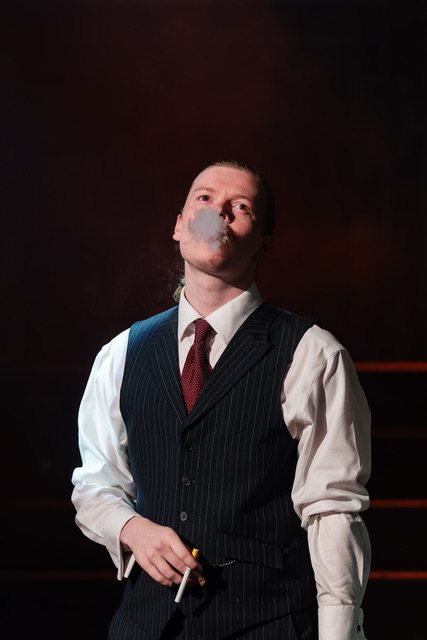
The props were used extensively by Nick Shadow – the mysterious figure who draws the young Tom Rakewell into a life of indulgence and ultimately destroys it – as well as by performers in the production’s bar scene.
The resulting production photographs show how a small stage prop can contribute to character, atmosphere and period without becoming the centre of attention.
A bargain with consequences
The Rake’s Progress, with music by Igor Stravinsky and a libretto by W. H. Auden and Chester Kallman, tells the story of Tom Rakewell, a young man who is offered the chance to transform his life overnight.
The offer comes from Nick Shadow, a seemingly helpful but deeply sinister figure who is ultimately revealed as the Devil.
Tom leaves Anne Trulove, the woman he loves, and follows Nick into the seedier corners of London. There, he is introduced to a world of pleasure, extravagance and increasingly disastrous decisions.
Nick encourages Tom to embrace different forms of vice and persuades him to marry the celebrated Baba the Turk rather than return to Anne. What begins as a promise of freedom gradually becomes a story of manipulation, debt and ruin.
British Youth Opera describes Stravinsky’s work as a dark comic opera in which “living life to the full” comes at a cost.
For the 2026 production, that warning was placed within the visual and cultural language of the 1980s.
Creating the production’s 1980s world
Although Stravinsky composed The Rake’s Progress around 1950, British Youth Opera’s production was set in the hedonistic 1980s.
The period offered a natural visual setting for the production’s themes. Status, excess and personal reinvention could exist alongside the darker consequences of unchecked ambition and self-indulgence.
Smoking was used as part of that visual language.
In the production, the cigarette helped convey Nick Shadow’s composure, sophistication and control. It also became a signifier of vice and of an era in which smoking was considerably more visible in bars, workplaces and social settings than it is today.
The production combined the individual cigarette props with theatrical haze to create a broader smoky atmosphere.
The effect was not simply to show people smoking. It helped establish the period and the world into which Nick Shadow draws Tom Rakewell.
Two performers, one Nick Shadow
The role of Nick Shadow was shared by two singers during the production’s four performances at Battersea Arts Centre.
Sam Young performed the role on 18 and 20 August, while Edward Wenborn appeared as Nick Shadow on 19 and 21 August.
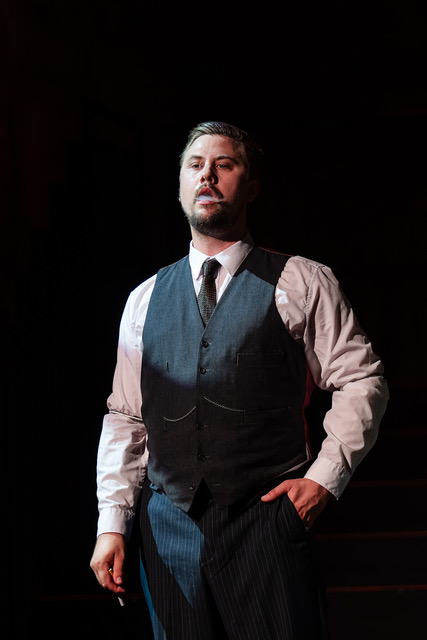
Both performers used the Stage Props cigarettes extensively as part of their portrayal of the character. Two female performers also used the props during the bar scene.
The photographs from the production show the two interpretations of Nick Shadow and demonstrate how naturally the cigarette became part of the character’s physical presence.
Whether held between the fingers or used to create a visible vapour effect, the prop supported the performance without distracting from it.
For Company Stage Manager Jenny Campbell, the practical experience was equally positive:
“As a Stage Manager I liked using these electronic cigarettes. They are very easy to use, safe for the ‘smokers’ and technical staff and look very effective on stage.”
— Jenny Campbell, British Freelance Company Stage Manager
A prop designed for performance
The difference between a consumer product and a professional theatrical prop lies in what the production needs it to do.
On stage, the cigarette must become part of the action. It should look convincing in the performer’s hand and allow the visible effect to be produced at the moment the scene requires it.
At the same time, it should be simple for performers and technical staff to manage throughout rehearsals and repeated performances.
The Stage Props system contains no tobacco or nicotine. There is no combustion, ash or open flame, and the replaceable filters contain only PG and VG, without flavouring or other additives.
The performer can create a visible vapour effect without needing to smoke a real cigarette or inhale the vapour into the lungs.
In The Rake’s Progress, this allowed the production to make smoking part of Nick Shadow’s character and the 1980s setting while keeping the effect under theatrical control.
Professional experience for emerging artists
British Youth Opera is the United Kingdom’s national opera training company. For more than 35 years, it has helped emerging singers, directors, conductors, designers, stage managers and other theatre professionals gain experience under professional production conditions.
Its summer programme places a full-scale opera in the hands of some of the country’s most promising early-career artists, supported by experienced theatre professionals.
The 2026 production of The Rake’s Progress was conducted by Oliver Cope, directed by Tom Deazley and designed by Alexandra Kay, with Sinfonia Smith Square.
For the young artists involved, the production provided the opportunity to work through the complete process of creating and presenting a professional opera – from early planning and rehearsals to technical preparation and live performance.
That made the project an especially appropriate setting for a professional prop system. The participants were not merely creating a convincing production for an audience; they were also gaining practical experience with the tools, decisions and working methods they may encounter throughout their future careers.
A small detail with a clear dramatic purpose
Smoking is only one small element within The Rake’s Progress.
But in a production built around temptation, pleasure and moral decline, the way Nick Shadow holds and uses a cigarette can tell the audience something before he says or sings another word.
The cigarette becomes part of his composure. Part of his sophistication. And part of the world of vice he offers to Tom.
At the same time, it helps locate the production in its chosen period. Together with the costumes, lighting, set design, body language and theatrical haze, it contributes to the unmistakable atmosphere of the 1980s.
The photographs from British Youth Opera’s production show Stage Props exactly where theatrical props belong: in the hands of performers, serving the character, the period and the story.
Stage Props in opera and theatre productions
Stage Props products are used internationally by theatres, opera companies, film and television productions, drama schools and professional performers.
If your production requires realistic smoking scenes without tobacco, nicotine, combustion or an open flame, you can learn more about our professional stage cigarette prop system here.